
Guide
Pre-purchase car inspections: how to run them in an Australian workshop
Last updated 23 November 2026
Short answer
A pre-purchase inspection is a paid, independent check of a used car’s condition for someone thinking of buying it. A workshop inspection should cover identity and history checks (VIN, PPSR, recalls), a structured walk-around, an under-bonnet and hoist inspection, a scan and a road test, then a written report that rates each item and estimates repair costs. Unlike a roadworthy it reports on condition, not just minimum safety, and because private sales come without statutory warranties it is often the buyer’s only real protection.
Buyers ring workshops every week asking for a pre-purchase inspection, often with the seller waiting and a deposit on the line. Done well, it is good, quick work that brings in a new customer who owns a car you now know inside out. Done badly, it is a one-page “looks fine” that comes back to bite when the gearbox fails a month later. This guide covers what Australian buyers are and aren’t protected by, what to check before and during the inspection, how to write a report a buyer can act on, how to price it, and where your own obligations sit.
Consumer law and registration rules below were checked on government sites in November 2026 (ACCC, state fair trading agencies, the PPSR and the Department of Infrastructure). Follow the links to check details before relying on them. The checklist is a general starting point, not a substitute for the manufacturer’s data for the vehicle in front of you.
Why buyers need a pre-purchase inspection
The biggest reason is what a private sale doesn’t come with. The ACCC’s December 2025 report on consumer issues in the sale of second-hand cars says state and territory statutory warranties, cooling-off periods and most Australian Consumer Law obligations do not apply to private sellers. A private seller still has to guarantee clear title, undisturbed possession and no undisclosed securities, but not that the car is any good. Consumer Protection WA puts it plainly: when you buy from a private seller, you are purchasing at your own risk, and it strongly recommends a pre-purchase inspection by a qualified mechanic.
Dealer sales are better protected but still worth inspecting. ACL consumer guarantees apply to cars bought from a licensed dealer, and states add their own statutory warranties. In NSW, for example, a used car under 10 years old with less than 160,000 km gets a dealer guarantee of 3 months or 5,000 km, whichever comes first, under the Motor Dealers and Repairers Act 2013. Older, higher-kilometre cars fall outside that. The ACCC also notes some dealers try to blame post-sale faults on the buyer when no inspection was done. Consumer Affairs Victoria suggests that if an inspection can’t be arranged before signing with a licensed trader, the contract should say “the sale is conditional on the purchaser’s satisfaction with an independent inspection report.”
Pre-purchase inspection vs roadworthy
Customers mix these up constantly, so explain the difference at the counter. A roadworthy (a safety certificate in Queensland, a pink slip in NSW, an RWC in Victoria) checks that a vehicle meets minimum safety standards on the day. The ACCC describes a mechanical inspection as a more comprehensive examination of the car’s overall condition and mechanical reliability, including the condition of its components.
So a car can pass a roadworthy with a slipping clutch, a weeping head gasket and tyres with 3 mm left, and a pre-purchase inspection should catch all three. If the buyer also needs a roadworthy to register or transfer the car, quote them as two separate jobs. See the state guides for QLD safety certificates, NSW pink slips and Victorian roadworthies.
Before the car arrives: booking and paperwork
- Take the buyer’s name, phone and email as the customer. They are paying you and the report is written for them, even though the car belongs to someone else. Record the seller’s name and where the car will be (your shop, the seller’s driveway or a dealer yard).
- Get the rego and VIN, the listing link, and whether it is a private or dealer sale. Ask when they need an answer, because buyers often have only a day or two.
- Ask the seller not to start the car before the inspection, so you can check a genuine cold start, and to have the service history and spare key ready.
- Make sure a PPSR search has been done. The official PPSR search costs $2 and shows any security interest, written-off and stolen status, rego expiry and the year, make, model and colour. Consumer Protection WA warns that unofficial sites charge much more for the same search. Older checklists still say “REVS”, the former NSW register, which the national PPSR replaced in 2012.
- Check the VIN on the government’s Vehicle Recalls site. Manufacturers contact the owner details they have on file, which can be out of date after a sale, so a used car can easily have a recall still open.
- For newer vehicles, search the VIN on the Register of Approved Vehicles. Under the Road Vehicle Standards Act 2018 (fully in force from 1 July 2021), the RAV replaced the need for physical compliance plates, so a newer car without a plate isn’t automatically a red flag. The RAV entry shows the build date and other details to check against the car.
- Agree the price and scope in writing before you start, and take payment or a deposit at booking. Buyers who decide not to go ahead have a habit of not paying for the report.
A pre-purchase inspection checklist
Work through the car in the same order every time, so nothing gets skipped when the seller is hovering. This is the order of the default pre-purchase template in Workshop Hub, which you can edit in Settings:
- Vehicle identification: VIN matches the PPSR, RAV or compliance plate, build date, rego and plates, and an odometer reading that makes sense against the service records. The ACCC notes that the ACT, SA, Queensland, Victoria, NSW and WA all have laws and penalties covering misrepresented odometer readings, private sellers included.
- Exterior body and paint: panel gaps, overspray and repaint signs, external rust, glass, lights and mirrors, and each tyre’s brand, age (date code) and tread in mm.
- Interior: seats, trim and carpets, controls and switches, A/C and heater, infotainment, camera and sensors, and any damp, mould or smoke smell.
- Electrics and accessories: battery and charging test, warning lamps on the dash, and aftermarket wiring for lights, dash cams or towbars.
- Under the bonnet: cold start behaviour, oil and coolant condition and level, leaks, belts and hoses, smoke and unusual noises.
- Engine: performance, compression or leak-down test if the buyer has paid for it, and whether the timing belt is due or overdue (or whether it is a chain engine).
- Transmission and drivetrain: gearbox or clutch operation, diff and transfer case on 4WDs, CV joints, boots and driveshafts.
- Steering and suspension: rack and pump, play, springs, shocks and bushes, ball joints and tie rods.
- Brakes: pad and rotor or drum condition with measurements, brake performance and park brake.
- Underbody on the hoist: rust and corrosion, oil and fluid leaks, the exhaust, and any sign of impact or structural repair.
- Road test: idle and take-off, power, gear changes, braking and ABS, noises, vibration and tracking, and behaviour at highway speed where you can do it safely.
- History and scan: service history or logbook sighted, an OBD scan with any codes noted, and the open recalls you found earlier.
- Overall summary: an overall rating, a written summary for the buyer, and the repairs you would prioritise.
Rating findings and writing the report
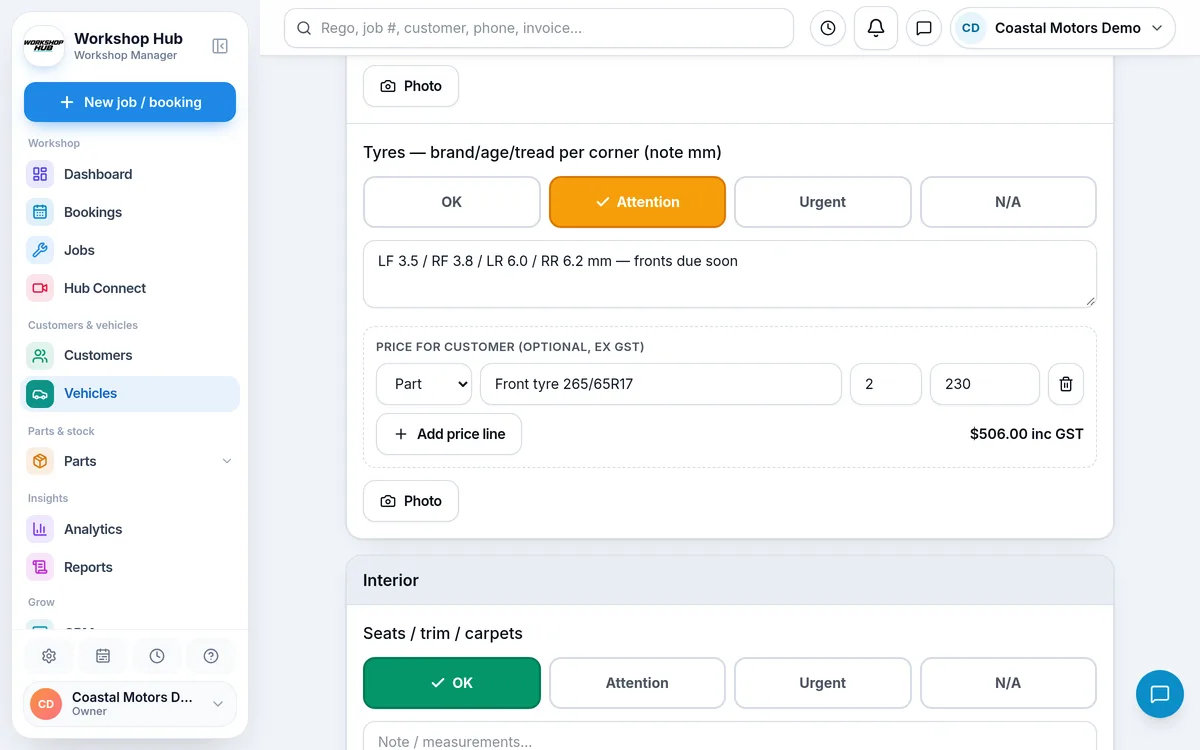
The report is what the buyer is really paying for, so make it something they can act on. Rate every item with a simple scale. Workshop Hub uses OK (green), Attention (amber) and Urgent (red), plus N/A for anything that doesn’t apply or wasn’t tested. Write measurements, not adjectives: “front pads approx. 4 mm, rotors lipped” is useful, but “brakes fair” isn’t. Photograph anything flagged, because a photo of a split CV boot settles arguments that a note can’t.
Then add an estimated cost for each flagged item, so the buyer can weigh the asking price against what the car really needs. Finish with a plain-English summary and an overall rating, and list what you did not check, such as a compression test they declined or a 4WD system you couldn’t test in the yard.
Worked example: a 2020 ute with 148,320 km
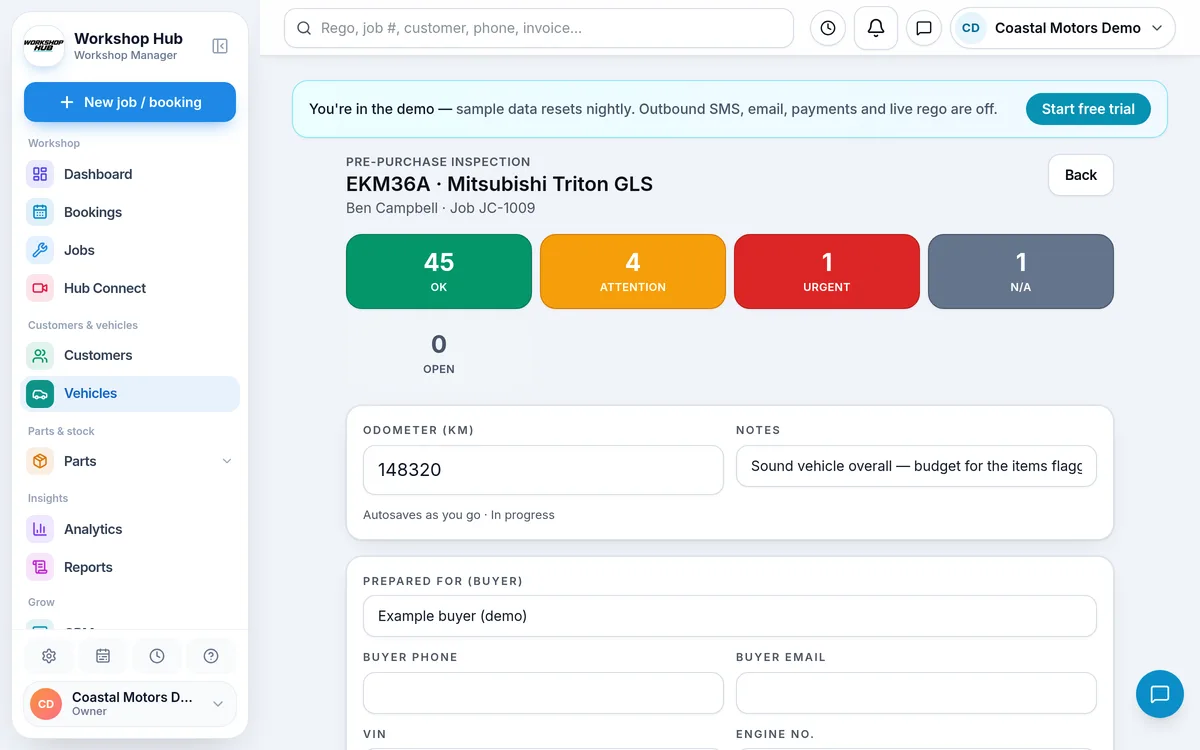
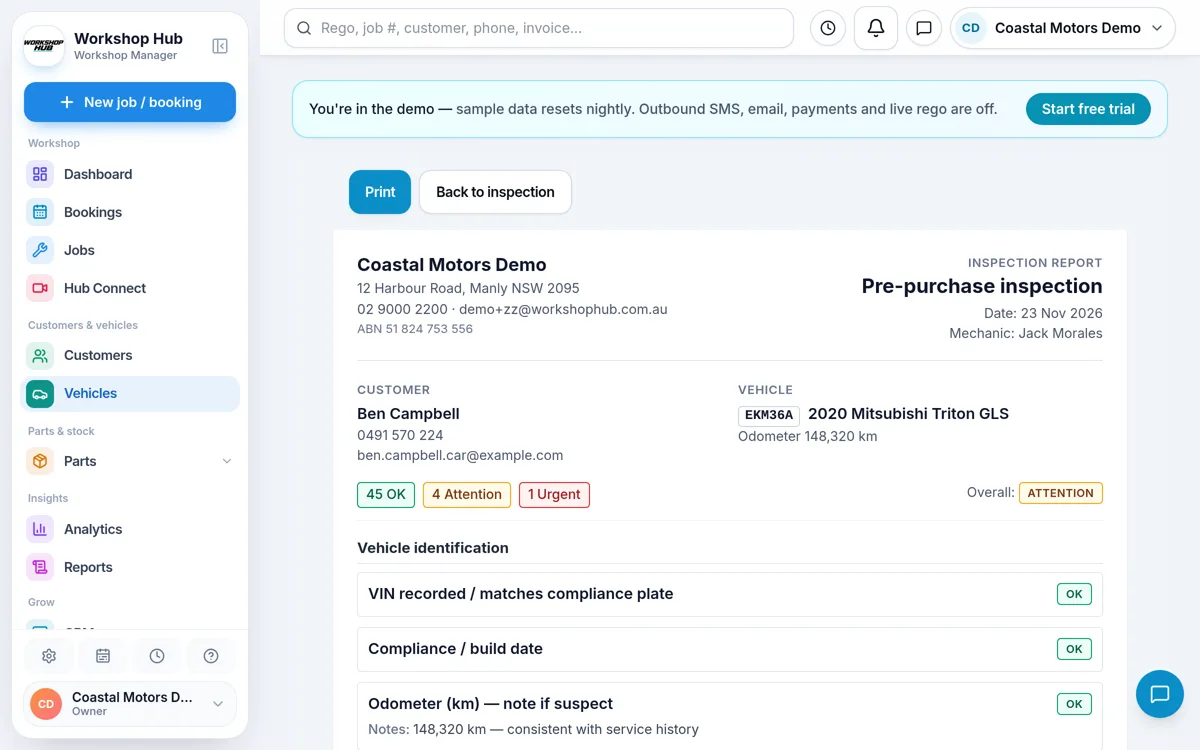
Example numbers from the Workshop Hub demo workshop (sample data, not a real customer): a buyer books a pre-purchase inspection on a 2020 Mitsubishi Triton GLS. The inspection comes back with 45 items OK, 4 Attention and 1 Urgent, and the overall rating is Attention: a sound vehicle, but the buyer should budget for repairs.
- Urgent: left-hand front outer CV boot split and throwing grease. Boot kit $65 plus 1.5 hours at $150 = $290 + GST ($319 inc GST).
- Attention: front pads approx. 4 mm with lipped rotors. Pads and machining $160 plus 1.2 hours at $150 = $340 + GST ($374 inc GST).
- Attention: front tyres at 3.5 and 3.8 mm. Two tyres at $230 = $460 + GST ($506 inc GST).
- Attention: rear shocks weak on the bounce test and misting. Two shocks at $140 plus 1 hour at $150 = $430 + GST ($473 inc GST).
- Attention: overspray on a rear tub rubber, showing a minor repaint with no structural signs. No cost, but worth mentioning to the buyer.
- Estimated total: $1,520 + GST ($1,672 inc GST). The buyer now has a clear list to take back to the seller. Report the facts and costs, and leave the decision and any price negotiation to them.
Your obligations: care, skill and scope
An inspection is a service, so the Australian Consumer Law guarantees apply to you. The ACCC says services must be carried out with an acceptable level of care and skill, at least as good as a competent provider with average skills and experience would give, and that these rights can’t be taken away by anything a business says. A line like “we accept no responsibility for anything missed” doesn’t protect you and can mislead customers about their rights. See the ACCC’s consumer rights and guarantees page.
What you can and should do is describe the service accurately. State in writing, on the booking and on the report, what the inspection includes: visual and functional checks, a scan and a road test, without dismantling. List extras such as compression tests as separate options. A clear scope sets the buyer’s expectations and makes it obvious what a competent inspection of that kind covers. Don’t promise what you can’t see (“no mechanical problems”), say so if you have any link to the seller, and never inspect a car your own business is selling. It is also worth asking your insurance broker whether your cover includes advice given in inspection reports.
What to charge
There is no regulated fee for a pre-purchase inspection, so price it from your own costs like any other job. Work out how long your inspection really takes, including the road test, the PPSR and recall checks and writing the report, then charge it at your proper labour rate rather than a token “check-over” price. The free labour rate calculator and the how to price labour guide show how to set that rate.
Example numbers: if an inspection takes 1.5 hours including the report and your rate is $160 an hour, that is $240 + GST ($264 inc GST). Add a set amount for travel on mobile inspections, and price options separately: compression or leak-down tests, 4WD and European vehicles that take longer, or a roadworthy done at the same visit. Publish a starting price on your website so buyers who are ringing around can book without a callback.
Mobile pre-purchase inspections
Many inspections happen in the seller’s driveway, which suits mobile mechanics well. It also limits what you can see. Without a hoist, the underbody, steering and suspension checks are partial, so say so in the scope and mark those items N/A or “visual from ground” rather than OK.
Group inspections by area where you can, and leave buffer time because sellers run late. Workshop Hub’s mobile mechanic software includes a day route with driving times between jobs on Shop and Pro+.
Running pre-purchase inspections in Workshop Hub
- Book it like any job. On the job card, open Checklists and choose Pre-purchase. Enter who it is prepared for: the buyer can differ from the vehicle owner on file, and their contact details stay office-only.
- The mechanic works through the checklist on a phone in the mechanic app, tapping OK, Attention, Urgent or N/A for each item and adding notes, measurements and photos. It autosaves as they go.
- The office adds optional price lines (ex GST) to flagged items, fills in the estimated repair costs shown on the customer report, and sets the overall result.
- Print the report or save it as a PDF, or share a link by text or email. Nothing is sent automatically. If the buyer goes ahead with the car, “Create quote from flagged items” turns the findings into a quote, and the job is invoiced with a GST tax invoice that syncs to Xero, MYOB or QuickBooks through the partnered integrations.
- Change the checklist in Settings under inspection checklist templates. New inspections use your list, and past reports keep the items they were done with.
Turning buyers into regular customers
Someone who has just paid you to inspect a car is the easiest new customer you will ever get. If they buy it, they already trust your judgement and have a list of work you priced. Offer to book the urgent items before they drive it far, put the car on service reminders, and ask for a Google review once the invoice is paid. Workshop Hub’s Google review management does that automatically on Shop and Pro+.
Inspections and roadworthy checklists are on Workshop Hub’s Shop ($129 a month + GST) and Pro+ ($189 a month + GST) plans, with Solo at $59 a month + GST. Every plan includes bookings, job cards, quotes and GST invoices, and there is a 14-day free trial. See pricing or call 1800 566 011.
FAQ
What does a pre-purchase car inspection include?
A workshop pre-purchase inspection usually covers identity and history checks (VIN, PPSR and recalls), exterior, interior and electrics, an under-bonnet check including a cold start, engine, transmission, steering, suspension and brakes, an underbody check on a hoist, an OBD scan and a road test. The buyer gets a written report rating each item, with estimated repair costs.
Is a pre-purchase inspection the same as a roadworthy?
No. A roadworthy (safety certificate, pink slip or RWC) checks that a vehicle meets minimum safety standards on the day. A pre-purchase inspection is a broader check of the car’s overall condition and mechanical reliability, including wear items and faults that would not fail a roadworthy.
Do I need a pre-purchase inspection when buying privately?
It is strongly recommended. The ACCC says state statutory warranties, cooling-off periods and most Australian Consumer Law protections do not apply to private sellers, so the buyer carries the risk. Consumer Protection WA recommends a pre-purchase inspection by a qualified mechanic and a PPSR check before buying.
How much does a PPSR check cost?
A search on the official PPSR website (ppsr.gov.au) costs $2. It shows whether there is money owing on the vehicle and its written-off and stolen status. Unofficial websites often charge much more for the same search.
How much should a workshop charge for a pre-purchase inspection?
There is no regulated fee. Price it from the time it really takes, including the road test, checks and report, at your normal labour rate. For example, 1.5 hours at $160 an hour is $240 + GST ($264 inc GST). Charge extras such as compression tests and travel separately.
Can a workshop exclude liability for a pre-purchase inspection?
Not from the consumer guarantees. An inspection is a service that must be done with acceptable care and skill, and the ACCC says these rights cannot be taken away by anything a business says. What you can do is describe the scope accurately in writing, such as visual and functional checks without dismantling, and list optional tests separately.
Why doesn’t a newer car have a compliance plate?
Under the Road Vehicle Standards Act 2018, vehicles entered on the Register of Approved Vehicles (RAV) do not need a physical compliance plate. Search the VIN on the RAV public search to confirm the entry and check details like the build date.
Can Workshop Hub produce a pre-purchase inspection report?
Yes, on the Shop and Pro+ plans. Start a pre-purchase inspection from the job card, rate each item OK, Attention, Urgent or N/A with notes and photos, add estimated repair costs, then print the report or share a link with the buyer. Flagged items can be turned into a quote.
Try Workshop Hub with your own jobs
14-day free trial — no card required